
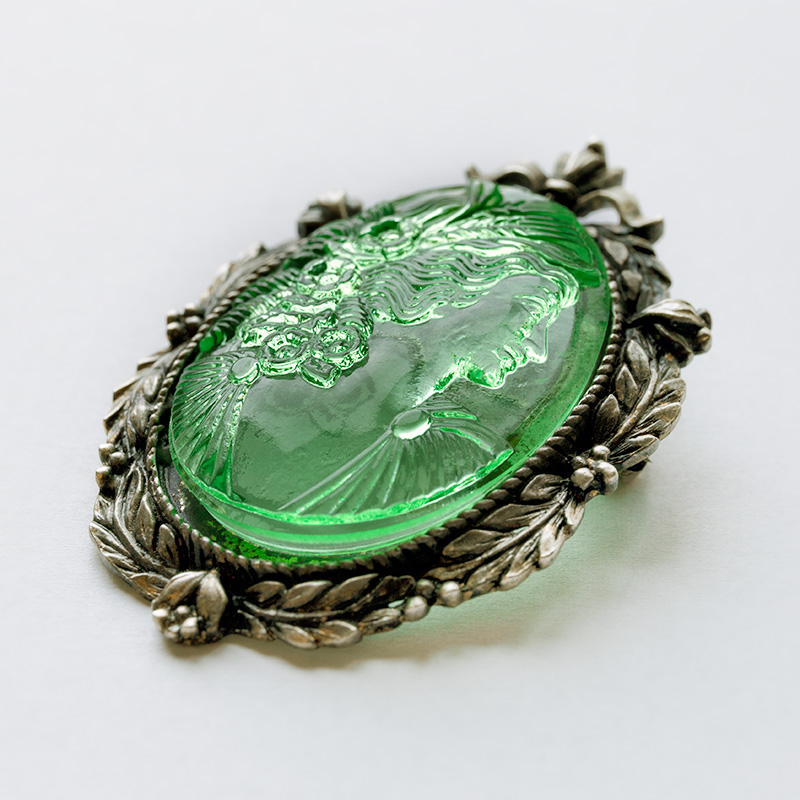
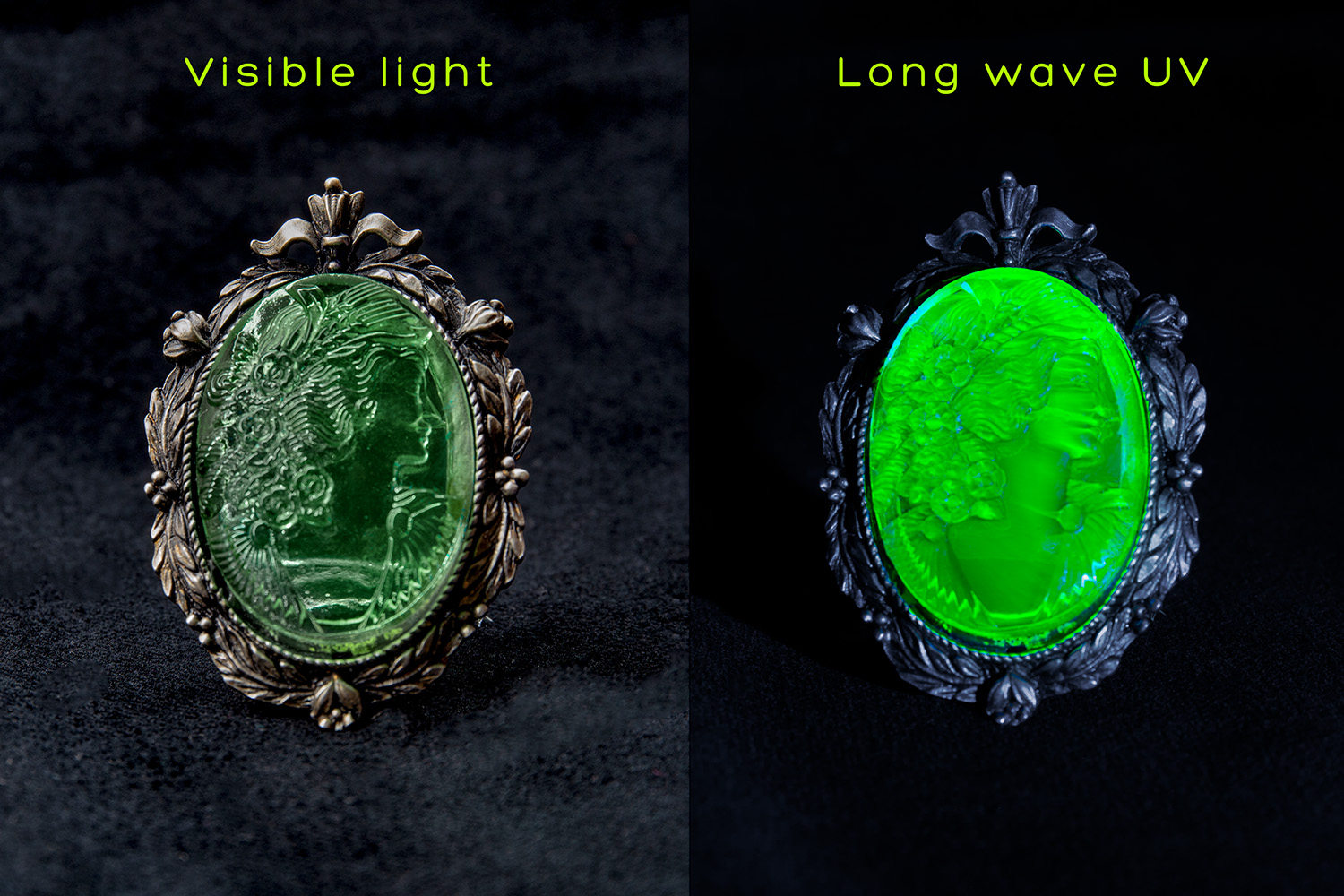
After some time, I am once again adding a new post. This time, we will focus on an Art Nouveau-style cameo, a substantial part of which is made of uranium glass.
As I mentioned in a previous post (link), the history of uranium glass production dates back to the first half of the nineteenth century. To be entirely accurate, however, the oldest known evidence of glass containing uranium surprisingly dates back to Roman times. Uranium was identified in yellow glass from a mosaic discovered in an imperial villa at Cape Posillipo near Naples [1]. Ancient glassmakers were, of course, unaware of uranium as a chemical element, and radioactivity itself was not discovered until the end of the nineteenth century. They probably used a mineral raw material that naturally contained uranium. The Roman fragment is therefore a radioactive artefact created approximately eighteen centuries before people understood the nature of radioactivity.
Martin Heinrich Klaproth identified uranium in pitchblende only in 1789, while the earliest known written reference to the deliberate production of uranium glass dates from 1817 [2]. Czech glassmaking, played a decisive role in its wider adoption. Beginning in 1834, Josef Riedel produced the yellow glass known as Annagelb and the green variety Annagrün. He named both colors after his wife, Anna [3]. Thanks to the great popularity of Czech uranium glass, its production subsequently spread from Central Europe to France, Britain, the United States, and other countries. The material was appreciated for its rich colors and its unusual ability to change appearance under different lighting conditions.
Uranium glass was produced on a large scale until the World War II. During the war, production was restricted or discontinued in many countries because uranium had become a strategic material. In the United States, it was not generally available for consumer glassmaking for approximately fifteen years. Production of some decorative objects resumed around 1959 [4].
Uranium glass brings together history, art, chemistry, and nuclear physics in a way that has few parallels. Its story extends from Roman mosaics through the glassworks of northern Bohemia and the development of Annagelb and Annagrün to modern museum collections and gamma-spectrometric measurements carried out by both professionals and amateurs.
But let us return to the cameo. I managed to buy this particular piece at a local second-hand market a few years ago for a ridiculously low price. It is therefore unlikely to be an exceptional historical artefact – but then again, who knows? :-)
It is known that older historical uranium-glass objects may exhibit characteristic gamma-spectrometric lines associated with Bi-214 and Ra-226. This is attributed to the relatively limited purification of the uranium ore used during the nineteenth century. More recent products generally do not contain these radionuclides, because purer raw materials were used and because insufficient time has elapsed for a new radioactive equilibrium to become established. Gamma spectrometry can also help determine whether the glass was colored using material derived from natural or depleted uranium. The use of depleted uranium became characteristic after the World War II. Fissile U-235 had become a strategic material, while large quantities of depleted uranium consisting predominantly of U-238 isotope were generated as a by-product of uranium enrichment.
So, what does the evidence reveal about my cameo?
The gamma spectrum was acquired using my Scintillix gamma spectrometer equipped with a 63 × 63 mm NaI(Tl) scintillation probe and operated with Theremino software. The measurement consisted of a 10-hour background acquisition followed by a 10-hour measurement of the uranium-glass cameo. The resulting spectrum was processed using InterSpec software (Sandia National Laboratories, link).
| Sample | Uranium glass cameo |
| Gamma spectrometer | Scintillix SCGS-01 |
| Scintillation probe | NaI(Tl) 3" |
| Integration time | 36000 sec. (10 h) |
| Background correction | yes |
| Shield | Graded shielding (lead-tin-copper) |
| Software | Theremino v.7.2 |
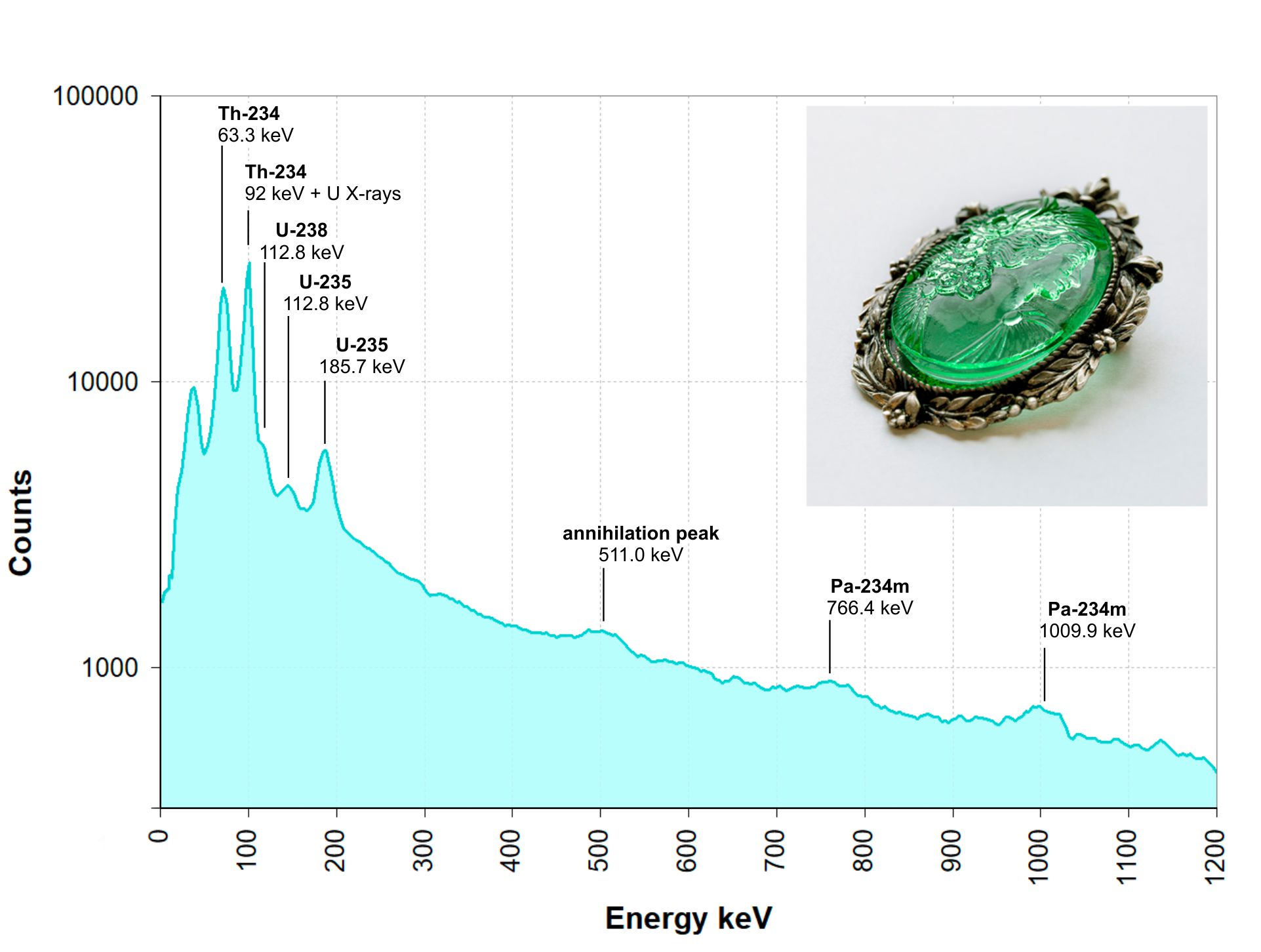
So, what can be clearly seen in the spectrum?
There is virtually no detectable contribution from Ra-226 or its progeny, particularly Pb-214 and Bi-214. This suggests that the uranium used to colour the glass had been chemically separated from the later members of the U-238 decay series. It could point to the production in 20th century, due to improved processes of uranium ore purification.
The spectrum contains a distinct peak at 112.8 and 185.7 keV, attributable to U-235. Signals associated with the U-238 decay chain are also present, particularly small peak at 112.8 keV and rather noisy Pa-234m peaks at 766.4 and 1001.0 keV. These two Pa-234m peaks are usually used for confirmation of U-238 presence, because Pa-234m is a short-lived daughter product that approaches equilibrium with U-238 within a few months.
All in all, distinguishing natural uranium from depleted uranium requires determination of the U-238/U-235U activity or isotopic ratio, ideally using calibrated high-resolution gamma spectrometer. For reference, the activity ratio is approximately 22:1 in natural uranium and typically around 50:1 to 80:1 in depleted uranium. At present, this is beyond the capabilities of my home setup. Therefore, any conclusions regarding the age of the artefact remain speculative and should be treated accordingly.
That’s all, folks…